CLINICALLY PROVEN
Physician Controlled Beveled Needle Tip
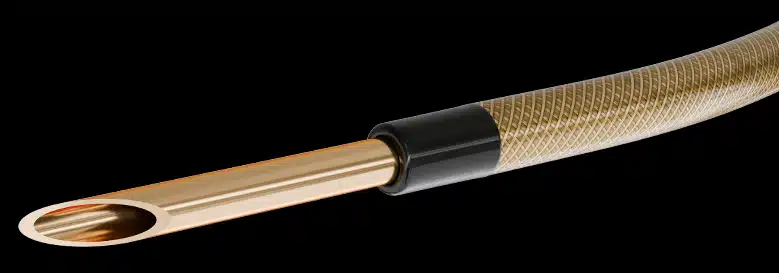
UNIQUE EXTENDABLE AND
ROTATING BEVELED
NEEDLE TIP
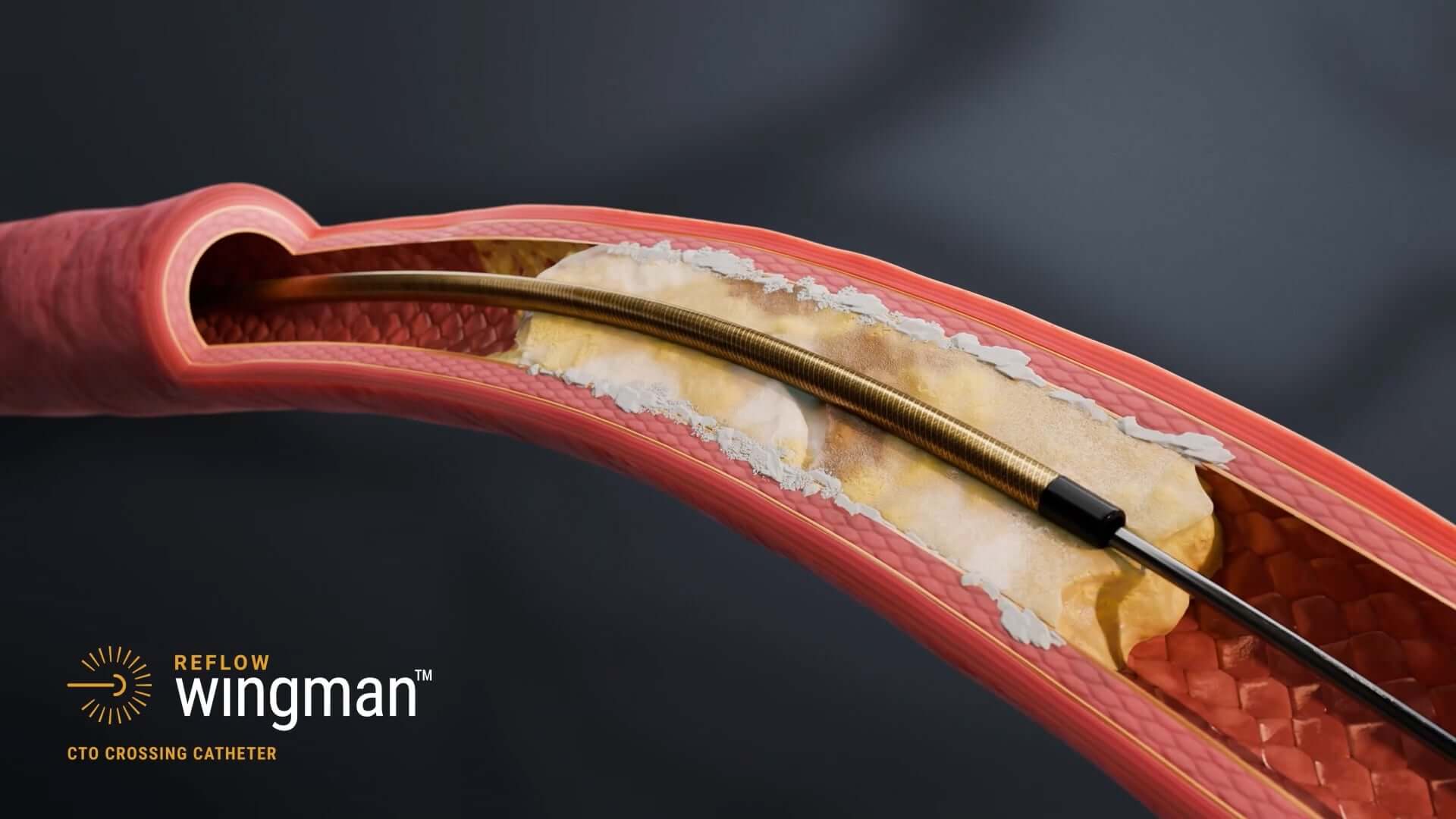
Simplifies entry into proximal cap and enables intraluminal CTO crossing
INTUITIVE
EASY-TO-USE
HANDLE
Allows you to simultaneously “push and twist” the beveled tip to anchor and penetrate the lesion
HIGH CROSSING SUCCESS RATE
AND SHORT CROSSING TIME
Clinically proven efficiency in the Wing-It Clinical Trial 1
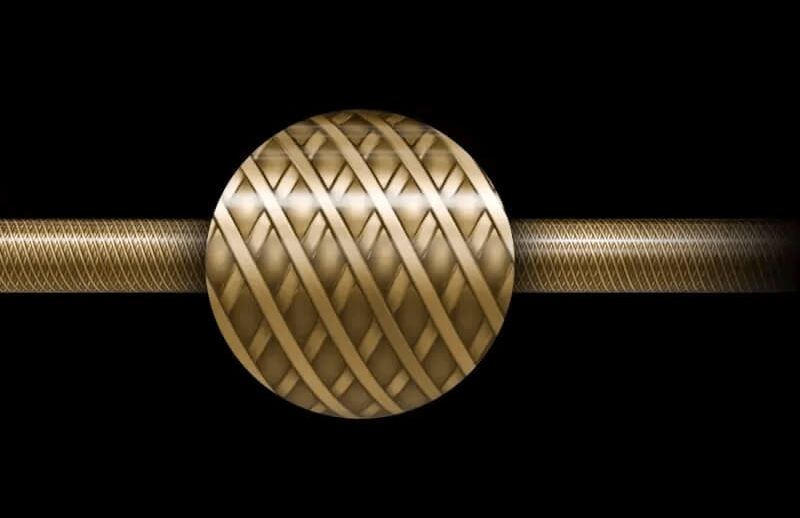
BRAID-REINFORCED
CATHETER SHAFT
Provides added strength for pushability through difficult lesions and kink resistance

HYDROPHILIC
COATING
Increases lubricity without compromising tactile feedback while enhancing trackability 2

TELESCOPING
COMPATIBILITY
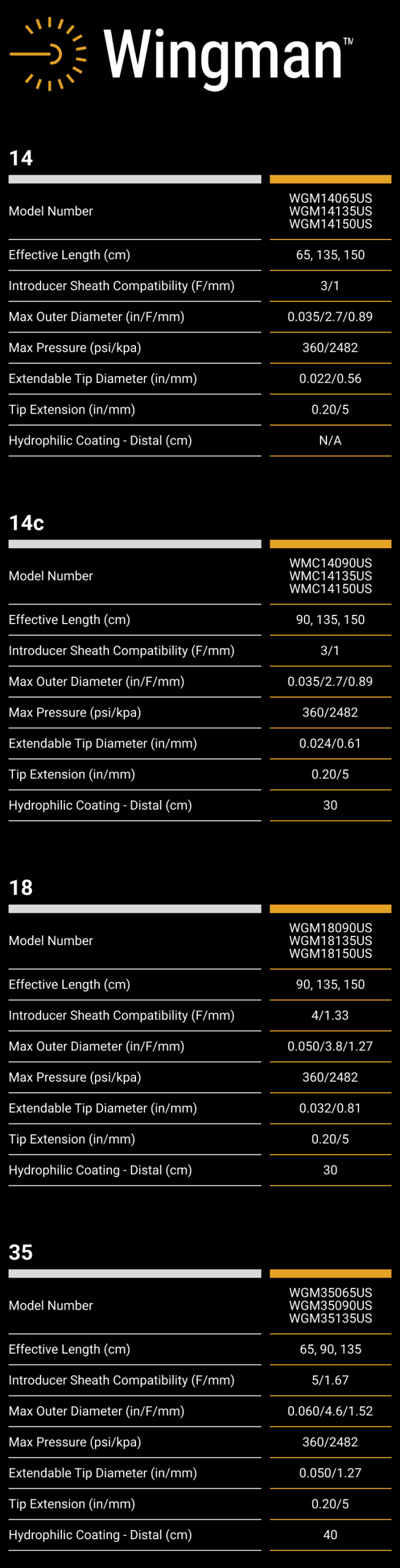
Wingman 14/14c allow telescoping with Spex LP 35 and Spex 35 Shapeable Support Microcatheters for angulation, additional support, or coaxial alignment

References
1. Laird JR, Mathews SJ, Brodmann M, Soukas PA, Schmidt A, The Wing-It Trial Investigators. Performance of the Wingman catheter in peripheral artery chronic total occlusions: Short-term results from the international Wing-It trial. Catheter Cardiovasc Interv. 2021;97:310–316. doi:10.1002/ccd.29366
2. Wingman 14 is not hydrophilically coated.
©2026 Reflow Medical, Inc. All rights reserved. Reflow Medical, Wingman, and The Pulse of Medical Ingenuity are registered trademarks or trademarks of Reflow Medical, Inc. Federal law (USA) restricts these devices to sale by or on the order of a physician. Refer to the Instructions for Use for a complete listing of the Indications, Contraindications, Warnings, Precautions, Complications, and Directions for Use.
Indications, Safety, & Warnings
CAUTION: Federal law (USA) restricts these devices to sale by or on the order of a physician. Refer to the Instructions for Use for a complete listing of the Indications, Contraindications, Warnings, Precautions, Complications, and Directions for Use.
Indications for Use
The catheters in the Wingman Family of Crossing Catheters (14/14C/18/35 – see specification table above) are intended to be used in conjunction with steerable guidewires to access discrete regions of the peripheral vasculature. Any one of these catheters may be used to facilitate placement and exchange of guidewires and other interventional devices, including facilitation of the intraluminal placement of diagnostic/interventional devices beyond peripheral stenotic lesions (including chronic total occlusions [CTOs]) and provide a conduit for delivery of saline solutions or diagnostic/therapeutic agents.
The Wingman 14C Crossing Catheters are also intended to be used in conjunction with steerable guidewires to access discrete regions of the coronary vasculature. In that area, they may also be used to facilitate placement and exchange of guidewires and other interventional devices and provide a conduit for delivery of saline solutions or diagnostic/therapeutic agents.
Contraindications
The Wingman 14, 18, & 35 Crossing Catheters are contraindicated for use in the coronary and cerebral vasculature. The Wingman 14C Crossing Catheters are contraindicated for use in the cerebral vasculature.
Warnings
• Hydrophilic wires prone to excessive swelling (e.g., ZipWire) should not be used with Wingman Crossing Catheters.
• Single Use only. Do not reuse/resterilize. Reusing the device could result in compromised device performance, cross-infection, and other safety related hazards.
• Do not use if device is open or packaging is damaged.
• Never advance, withdraw, or rotate an intravascular device against resistance until the cause is determined by fluoroscopy.
• This device contains nickel and should not be used in patients with known allergies to nickel.
Precautions
• Store in a cool, dry place. Protect from direct sunlight and high temperatures.
• Use only appropriately sized ancillary device, as shown in the Specifications below.
• Maximum Infusion Pressure: 360 psi (2482 kpa)
• Use the catheter prior to the “Use By” date specified on the package.
• The catheter should only be used by physicians qualified to perform percutaneous, vascular interventions.
• Precautions to prevent or reduce clotting should be taken when any catheter is used in the vascular system. Use of systemic heparinization and heparinized saline solution should be considered.
• Exercise care while handling the catheter during procedure to reduce the possibly of accidental damage, kinking or bending.
• Manipulation of the catheter should only occur under fluoroscopy.
Complications
Vascular catheterization and/or vascular intervention may result in complications including but not limited to:
• Vessel dissection, perforation, rupture, or total occlusion
• Infection
• Hematoma
• Unstable angina
• Embolism
• Hypo/hypertension
• Acute myocardial infarction
• Arrhythmia, including ventricular fibrillation
• Death
If the catheter is damaged, this product may cut into a blood vessel wall. Extreme caution needs to be taken when removing a damaged device. In the case of complications resulting from the removal of the entire system, stop immediately the procedure, and perform appropriate treatment at the discretion of the physician.
©2026 Reflow Medical, Inc. All rights reserved. Reflow Medical, Wingman, and The Pulse of Medical Ingenuity are registered trademarks or trademarks of Reflow Medical, Inc. Federal law (USA) restricts these devices to sale by or on the order of a physician. Refer to the Instructions for Use for a complete listing of the Indications, Contraindications, Warnings, Precautions, Complications, and Directions for Use.
QUESTIONS?
TALK TO A REFLOW PRO.
For more information, please send us your question or request today.
A Reflow pro will get back to you.